Healthcare · clinic and dental
Clinic and dental management system
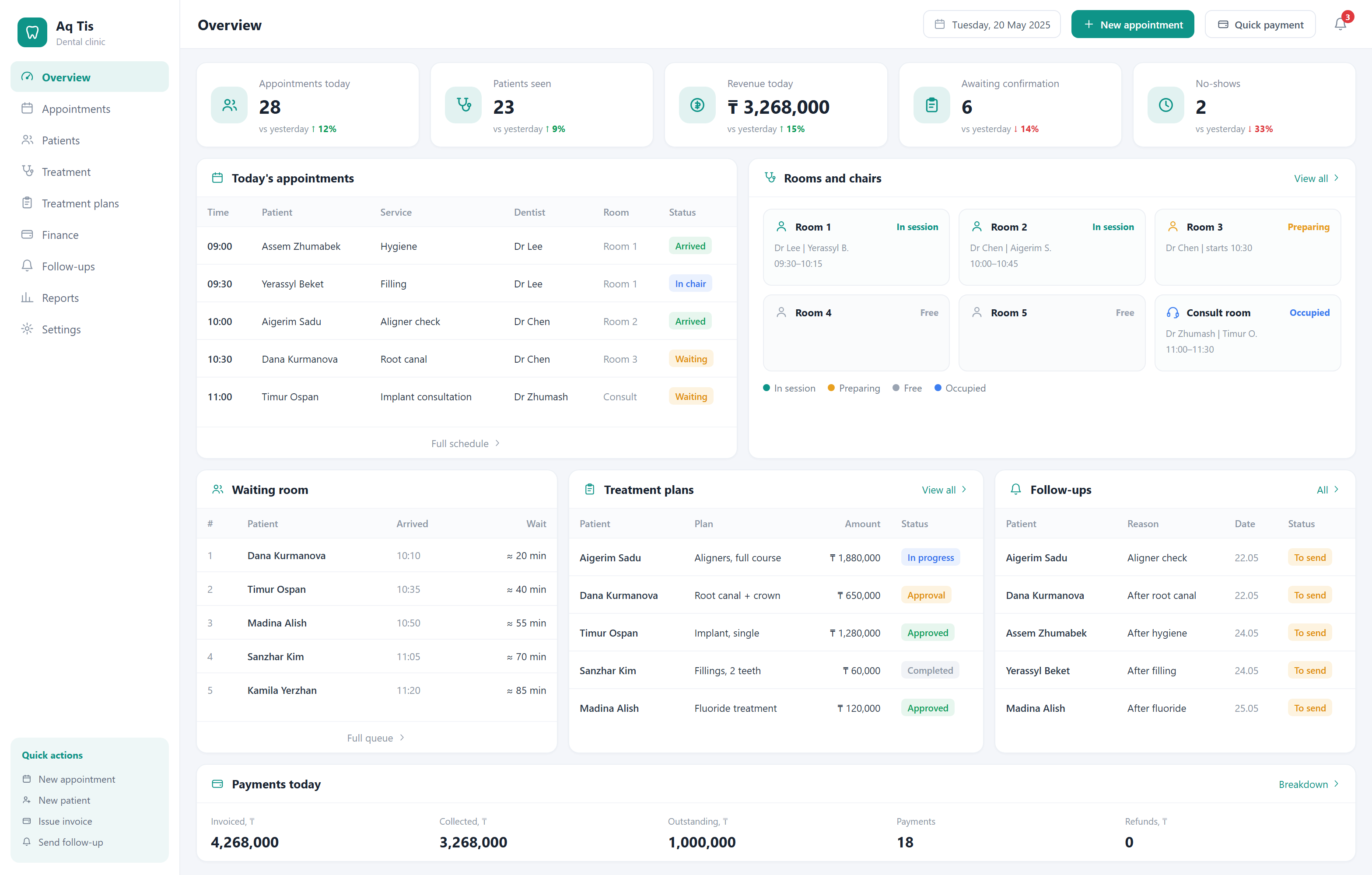
The usual setup: bookings in a notebook at reception, records in paper folders, payments in yet another spreadsheet. A patient sees a different doctor and has to tell the whole history again. This system links booking, records, treatment plan and payment into one line — one patient file that any doctor can open.
What it solves
The record cannot be found, so the patient repeats everything
Paper records are filed by surname; one letter spelled differently and the file is gone. The system opens the file by phone number — treatment history, imaging and prescriptions all on one page.
Treatment stops halfway through
Implants, orthodontics and physiotherapy run as courses. When a course breaks off nobody follows up, and you lose both the revenue and the reputation. The system schedules the next stage from the treatment plan and reminds the patient.
Revenue share cannot be worked out
Who treated whom, which materials were used, what was actually collected — at month end it is all recollection. Every procedure is attached to a doctor and to materials, so workload and share calculate themselves.
Before and after

- Bookings in a paper diary; rescheduling means crossing things out
- Records in a folder — a different doctor has to ask everything again
- A course breaks off and nobody knows who to chase
- Doctor shares are pieced together at month end from memory and receipts
- Online bookings land in the schedule and clashes are blocked
- A phone number opens the whole file, history on one page
- The treatment plan schedules the next stage and reminds the patient
- Every procedure ties to a doctor and materials; shares calculate themselves
Capabilities
Doctor schedules and online booking you can put on 2GIS and Instagram
Electronic records: complaint, examination, diagnosis, prescription
Tooth chart and imaging archive with visit-by-visit comparison
Treatment plans split into stages with progress tracking
Staged payments, service packages and prepaid balances
Automatic recall, review and hygiene reminders
Doctor workload, material consumption and revenue share
Private general clinics, dental and orthodontic practices, aesthetic medicine and physiotherapy centres, and small specialist clinics that treat patients in courses.
FAQ
Patient data is sensitive — where is it stored?
The system can be deployed entirely on your own server so the data never leaves your premises; medical clients almost always choose this. Have your legal adviser confirm the exact compliance wording for your actual situation — we will supply the technical description to support it.
Our doctors want to work from a tablet — is that possible?
Yes. The interface is built for tablet and phone as well: the doctor records notes and photos on a tablet in the surgery, reception takes payment on a desktop, and both see the same data with nothing to copy across.
How much does a system cost?
It depends on the feature set, how many locations you have and whether hardware integration is needed. Using a ready module costs significantly less than building from zero. We can give a range after the first conversation, and once the scope is agreed the price is fixed — we do not bill by the hour.
How soon can we start using it?
If the module is used largely as-is, 2–3 weeks. If it needs substantial adaptation to your process, usually 4–6 weeks. The timeline is stated in the proposal.
Where is the data stored? Can it be on our own server?
It can. By default the system runs on servers we maintain, which is simpler for you. If you have compliance or internal control requirements, we deploy entirely on your server or on a machine in your premises, and data never leaves your network.
Other systems
Gym membership system
Retire the paper log and the spreadsheet: memberships, personal training and renewal reminders in one place.
QR self-ordering system
Guests scan, order and pay themselves while the order goes straight to the kitchen — fewer queues, fewer mistakes, lower staffing cost.
Internet café management system
Session billing, client balances and seat status on a single screen at the front desk.